
By Tracie Sullivan, For Iron County Today
For several nights after returning home, Dallin Brooks would sit upright in bed believing he needed to report for duty.
Somewhere between sleeping and waking, the Iron County deputy attorney could see SWAT instructors in his room, ordering him into formation or telling him to move into position. It would take a moment before he remembered he was home and no longer racing against the clock at SWAT school.
“I’m still not even realizing that I’m dreaming,” Brooks said. “I’m having this experience, but I convince myself that, ‘Oh, actually, it’s not urgent right now. I can lay back down.’”
The dreams were a lingering echo of Ogden Metro SWAT’s Hell Week, a 96-hour course compressed into six days of tactical training, physical exhaustion and little more than three hours of sleep each night.
Brooks was not required to attend. As a prosecutor, he will never be the one breaking through a door or confronting an armed suspect.
But if he was going to advise the officers who do, Brooks wanted to understand their world.
“I just figured it’s probably the best thing to do to understand what they go through and to help me as an attorney when I am advocating for them, when I’m advising and training them on legal updates,” he said. “I can relate much better to what they do.”
Brooks began attending Iron Metro SWAT’s weekly training sessions in July, about a month before leaving for Ogden. He also increased his running and added CrossFit-style workouts to his regular exercise routine.
It wasn’t enough.
“The demand at Hell Week was far more than I expected,” he said.
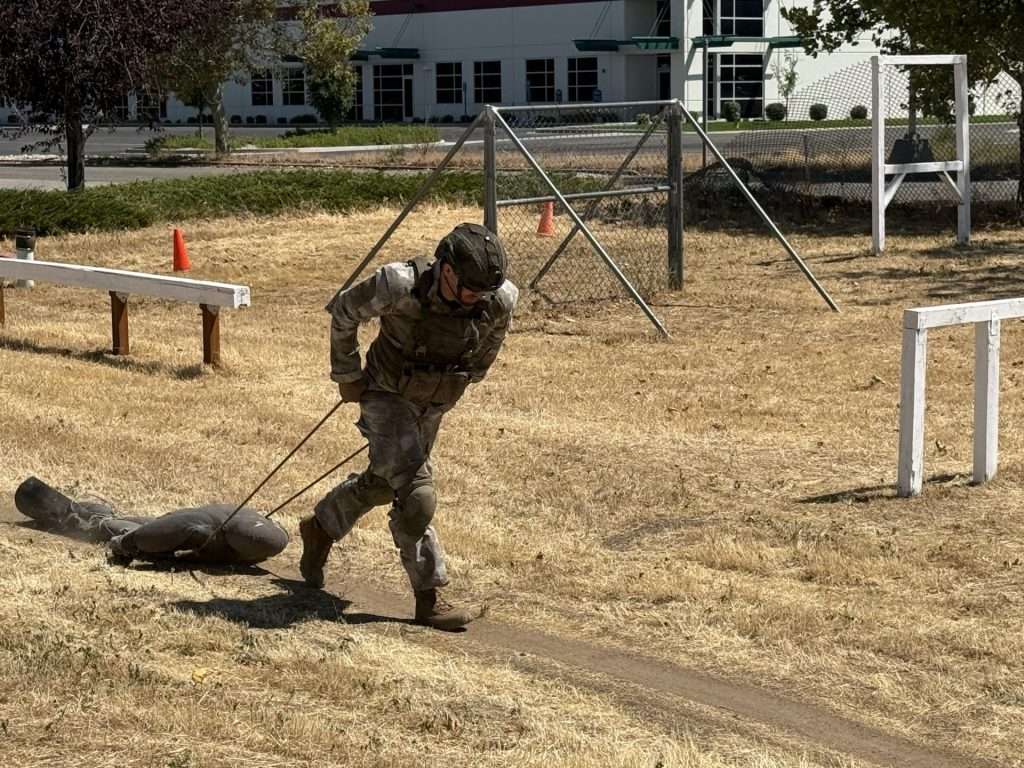
Each morning began with about an hour of intense physical training, often involving running while carrying teammates on stretchers, moving as a group beneath a massive log or sprinting forward and backward up hills.
If someone fell behind, those ahead were sent back to retrieve them. If an entire team lagged, members might be ordered to hold a squat until everyone caught up.
Then came another full day of tactical exercises beneath the August sun, most of it performed in heavy gear weighing around 25 to 30 pounds.
“I’ve never sweat so much in my life in one day and then drank so much water to try and keep up with it,” Brooks said.
The course began Sunday morning and continued through Friday afternoon. Some nights ended around midnight. Others stretched until nearly 2 a.m.
Even after instructors released them, participants still had to return to their dorms, clean their firearms, shower and then prepare their gear for the next morning. By the time Brooks climbed into bed, he generally had about three hours before he had to be ready to go again at 5:45 a.m.
Every hour he wasn’t sleeping was spent on his feet.
“By the end of it, you could just hardly stand to stand still,” Brooks said. “It felt so much better to walk or run than to stand still.”
The closest thing to a break came after lunch, when participants sat through approximately two hours of classroom instruction. But falling asleep meant the entire team could be sent outside for more physical training.
“We were all taking our keys out, stabbing our legs and our hands, trying to stay awake,” Brooks said. “Finally, you’re like, ‘I just have to stand up.’”
The firearms exercises presented a different challenge.
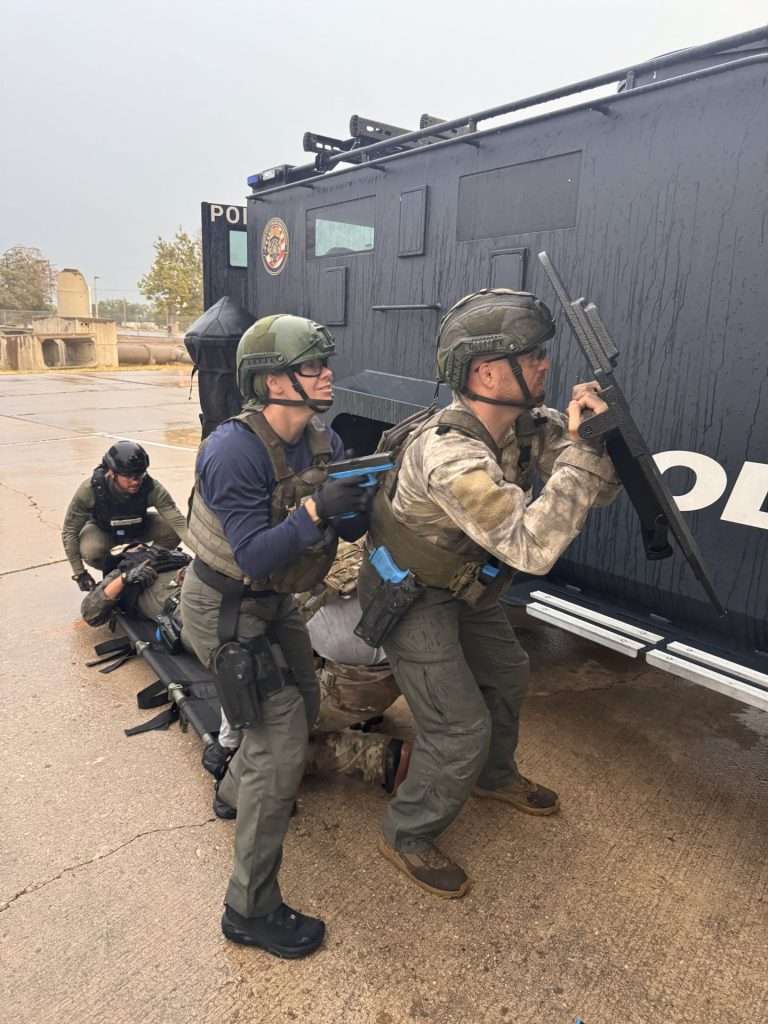
Unlike the law enforcement officers around him, Brooks had only recently begun receiving tactical firearms instruction. During simulated hostage rescues, participants entered a building carrying weapons that fired rubber projectiles and had to quickly distinguish the hostage from the person threatening them.
A mistake meant more than failing the scenario.
“If we shot the hostage, then that was bad news for us because the instructors would take us out and have us do a whole bunch of really hard PT stuff in our full gear out in the sun,” Brooks said.
The experience gave him new respect for officers who must make those decisions when the weapons and consequences are real.
“I didn’t want to go through and be the guy that messed everyone up,” he said. “It just kind of made me have a ton of respect for these guys who do it in real life.”
Brooks had another concern going into the course. He underwent two procedures on his knee this year, including one about a month before Hell Week to remove an object floating inside the joint.
His knee swelled as the week progressed, but Brooks had already decided that only an injury serious enough to physically remove him from the course would stop him.
“I just knew that I wasn’t going to quit,” he said.
Brooks and Cedar City Police officer Daisy McKern were the only members of the local group to complete the course. When it came down to the two of them, Brooks said neither wanted to leave the other to finish alone.
They also tried to remain positive, joking with the other participants and informally competing to see who could wake up with the best attitude.
That mindset became especially important after the first day.
Sunday was not even a full day, but it was the hottest and one of the most physically punishing. By the time it ended, Brooks found himself thinking about the five days that still remained.
“It was the longest day I think I’ve experienced,” he said. “I just had to keep saying, ‘Let’s focus on the next thing. Just get through the next thing.’ Don’t think about the whole thing as a whole.”
Hell Week was designed as a demanding school, not an exercise intended to force participants to quit, Brooks said. Instructors challenged them physically and mentally while teaching tactical skills they could carry back to their respective teams.
One of those challenges involved entering a shipping container filled with CS gas. Participants initially wore gas masks, but were required to remove them, state their names, identify their SWAT teams and say how long they had served.
Brooks took a deep breath before removing his mask and managed to deliver the required information. Then he unnecessarily corrected himself, explaining that while he had worked for the Iron County Attorney’s Office for two years, he had not been on SWAT that long.
The instructor accompanying him thought he might be immune to the gas since he was able to talk a lot while still standing in it.
He wasn’t.
“It seriously burns so bad to breathe in and breathe out,” Brooks said.
The gas was another mental test, he said. Although his body told him he could not breathe, he knew he was still receiving oxygen and had to remain calm until he reached fresh air.
By Thursday, Brooks had slept no more than three hours a night for several consecutive nights. Yet he was surprised by his ability to follow instructions, respond to feedback and think clearly through fast-moving scenarios.
“You can do way more than you think you can with very little sleep,” he said. “I really thought that by the end of the week I would be almost incoherent but I wasn’t. I was still able to think clearly, react and move quickly. It was surprising to me because the sleep thing worried me. I didn’t know how I would do with only two or three hours of sleep a night.”
The course ended Friday with weapons qualifications, a shooting competition and what instructors called a “fun run.”
Participants ran approximately 2 miles while keeping one teammate off the ground, collecting trash and stopping at stations where they were required to demonstrate skills learned throughout the week. They cleared rooms, crossed open spaces without being detected and crawled through a river, mud, dirt and weeds.
“Never a dull moment,” Brooks said.
Iron County Attorney Chad Dotson said Brooks also recorded the fastest obstacle-course time in the class, outperforming experienced law enforcement officers despite his lack of previous training, fatigue and injured knee.
“I’ll brag for him since he won’t do it,” Dotson said.
Brooks is the second prosecutor in the Iron County Attorney’s Office to complete Hell Week. Deputy County Attorney Sam Woodall previously finished the course and also serves with Iron Metro SWAT.
Brooks will now join Woodall as a legal adviser to the team. Neither attorney participates in tactical operations as an officer, but remains on call during SWAT responses to review search and arrest warrants and answer legal questions as situations unfold.
The prosecutors will also provide regular instruction on changes in case law involving searches, warrants, use of force and other issues affecting tactical operations.
Dotson said having prosecutors undergo the same training as law enforcement officers helps both sides better understand one another’s responsibilities.
“We always want law enforcement to see how things go on our side, so I think it’s important for us to put ourselves out there and say, ‘Hey, we’re willing to see how things are on your side too,’” Dotson said. “Those relationships are critical to successfully prosecuting cases and keeping the community safe.”
Hell Week was not a vacation, Dotson said, and Brooks returned to a full caseload and a week of work waiting for him.
Still, Dotson said the professional and personal value outweighed the sacrifice.
“Anytime you can accomplish difficult things, it lets you know that you can get through challenges,” he said. “Pushing yourself to get through hard things is helpful in all facets of your life, career, family, all of it.”
Dotson said he was proud of Brooks for stepping outside his comfort zone and completing a course that even some experienced law enforcement officers do not finish.
“I think that says a lot about his character,” he said.
Days after returning home, Brooks said the dreams were beginning to fade. But the lesson that carried him through Hell Week remained: Don’t measure the distance still ahead. Just complete the next task.
“If you take it as a whole, I think you really struggle,” he said. “Just do it one bit at a time.”