

(Jan. 22, 2025) – Utah’s lackluster snow season continues to be a concern. 95% of the state’s water supply comes from snowpack. Refilling reservoirs is less likely if the trend of dismal snowstorms continues. 2025 was the warmest year on record for Utah, according to the National Weather Service. 

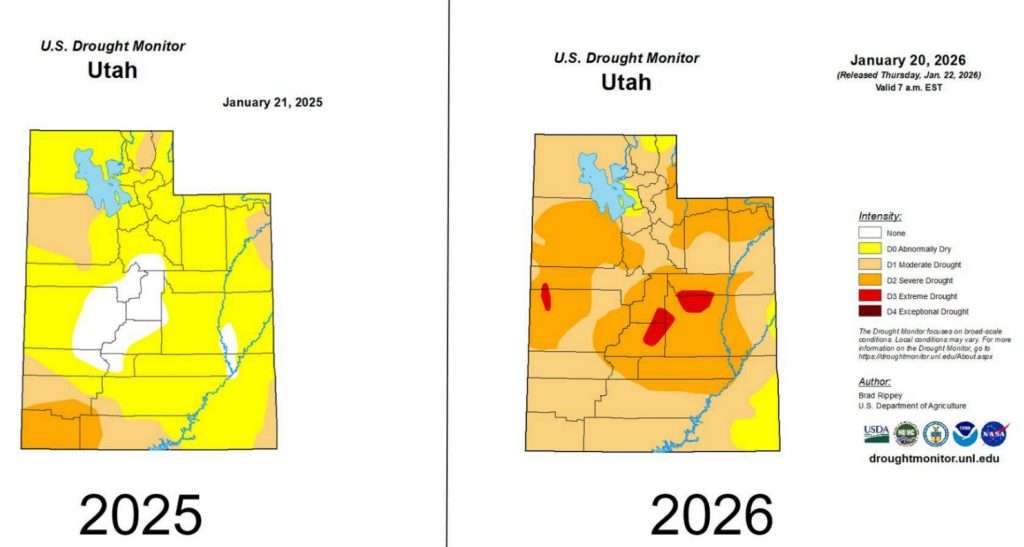
The northern portion of the state is doing slightly better than other areas, but is still recording below-normal levels. 94% of the state is currently experiencing some form of drought. Last year at this time, 20% of the state was in drought. 

“As the old saying goes, ‘In Utah, we are either in drought or preparing for the next one’,” Joel Williams, interim director at the Utah Division of Water Resources, said. “We can all see that our water situation is not looking great. For those looking to prepare, water conservation tips and tricks can be found at Slowtheflow.org. 

Reservoirs are currently above-normal for this time of year. Some reservoirs (like Strawberry, Jordanelle and Deer Creek) have room for multiple years of storage, while other reservoirs only contain water for about one year. 

As noted in the Natural Resources Conservation Service’s January 1st Water Supply Outlook Report, atypical snowpack conditions so far this winter have been particularly challenging for modeling snowmelt runoff. 

Reservoir storage helps us preserve water for use in dry summer months and drought years. To encourage water conservation among Utahns, the Department of Natural Resources continues to promote initiatives such as the Agricultural Water Optimization Program for farmers and SlowtheFlow.org for residents. These programs aim to educate and incentivize water-saving practices, ensuring Utahns become more drought-resilient and prepare for future conditions. Many indoor water-saving tips are available on the Slow the Flow website.  

" data-pos="top" value="0" max="100">
screenshot 2026 01 22 153349
Graphic compares Utah’s current drought situation to 2025. Currently, 94% of the state is in the moderate category of drought and 2% in extreme drought. Last year at this time, 20% of the state was experiencing moderate drought. Source: https://droughtmonitor.unl.edu/CurrentMap/StateDroughtMonitor.aspx?UT

Utah Water Conditions Update1 min read

By Michael Sanchez, Utah Division of Water Resources

SALT LAKE CITY (Jan. 22, 2025) – Utah’s lackluster snow season continues to be a concern. 95% of the state’s water supply comes from snowpack. Refilling reservoirs is less likely if the trend of dismal snowstorms continues. 2025 was the warmest year on record for Utah, according to the National Weather Service. 

The northern portion of the state is doing slightly better than other areas, but is still recording below-normal levels. 94% of the state is currently experiencing some form of drought. Last year at this time, 20% of the state was in drought. 

“As the old saying goes, ‘In Utah, we are either in drought or preparing for the next one’,” Joel Williams, interim director at the Utah Division of Water Resources, said. “We can all see that our water situation is not looking great. For those looking to prepare, water conservation tips and tricks can be found at Slowtheflow.org. 

Reservoirs are currently above-normal for this time of year. Some reservoirs (like Strawberry, Jordanelle and Deer Creek) have room for multiple years of storage, while other reservoirs only contain water for about one year. 

As noted in the Natural Resources Conservation Service’s January 1st Water Supply Outlook Report, atypical snowpack conditions so far this winter have been particularly challenging for modeling snowmelt runoff. 

Reservoir storage helps us preserve water for use in dry summer months and drought years. To encourage water conservation among Utahns, the Department of Natural Resources continues to promote initiatives such as the Agricultural Water Optimization Program for farmers and SlowtheFlow.org for residents. These programs aim to educate and incentivize water-saving practices, ensuring Utahns become more drought-resilient and prepare for future conditions. Many indoor water-saving tips are available on the Slow the Flow website.  

Share

Leave the first comment